Monday, June 30, 2008

Blast Furnace Gardening

The garden is not doing too well. Starting about 2 weeks ago, we had 9 days in a row over 110. Considering that an average summer only has 10 days over 110, that was a brutal start to the hot season. Meanwhile, our (NEW!) air conditioner was having problems. It kept over-heating and shutting down for 4 hours at a time. The inside temp would rise to about 90 and we did not feel up to going outside and weren't sure what to do anyway. In retrospect, I probably should have at least hosed everything down in the morning and late evening. I'm a little worried about the peach trees, they are awfully yellow. The rest of the new trees seem OK. The citrus are a bit scorched but better than they used to be before creating the orchard area with all the mulch and inline irrigation.

The melons are great. The honeydew was one of the best and sweetest I've ever eaten. Here's the latest harvest - the sunflowers are from the CSA, not my garden. Next year I do think I'll plant sunflowers. The picture shows the first honeydew, the second watermelon and the third cantaloupe, as well as a few last tomatoes. The fuzzy, dewy texture of the newly picked plants, especially the okra and the melons, is just amazing. For the record, we picked the first melons about a week ago.

A lot of plants have died. All the cucumbers, most of the tomatoes and the peppers except those in deep shade.
The fig tree may not make it.

Tuesday, June 17, 2008

Heat

Well it was hot before but now it's really hot. I went outside at 5 AM yesterday and again today and it was already quite warm outside. Some of the new trees, especially the peach trees, seem to be yellowing a bit, which I find alarming. This morning I went out early and added extra water with a hose. Just now I noticed that one of the huge melon plants, the one on the east side, is wilting. I hope it rebounds tonight. I'm wilting too!

Sorry I haven't uploaded any pictures recently. It's not hard to do but I have to look up the process each time and now I have mis-placed the cable. Soon.

Saturday, June 14, 2008

Birthday Girl and Garden

Notice the new Indian lightweight clothes - very cool in this heat.

Here's one of the watermelons:

Zucchini, and the sea of melons where the watermelon picture was taken is behind the raised planter.


The harvest - tomatoes, zucchini, lemon cukes, one eggplant, the first peppers, baby squash.

Thursday, June 12, 2008

My Share

I've joined a CSA. If you think that means we must have an awful lot of veggies - ours plus the CSA's - well, you're right. But it's fun. The CSA share includes a dozen eggs (from some very happy chickens) and a big bunch of flowers, which I seldom buy for myself. It's educational to get Maya's Farm's veggies and compare to mine. Her cucumbers look just like mine but hers are delicious and mine are bitter. In fact, I pulled out two huge cucumber plants and just left the lemon cucumber. It's great, and the skins of the cucumbers are not tough. Stella told me that the secret is to pick before they actually turn yellow.

Maya's share also includes a big bunch of Italian parsley and micro-arugula or baby lettuce. She included some really big squash and last week I made stuffed squash, filled with a Greek meat sauce (like you make for moussaka) and topped with cheese. I'd never made stuffed squash before.

I haven't written much because I've been sick and not had much energy. Also I've had to put in extra hours at work so that I can get really for a longish leave of absence starting mid July.

But the garden is doing great. It's hot now but still cool in the mornings. The plants in pots in the shade are doing especially well. The melons are amazing. I'm going to have to read up on how to know when they are ripe. I think I remember that the undertone turns yellow/gold and the fruit separates easily from the vine. I can now see which ones are watermelon and which are cantaloupe. The watermelon plants have deeply divided leaves. I have several varieties each of cantaloupe and watermelon. I think that the honeydew have not fruited yet, but I planted them later. Next year I'll have to start melons from seed to get more varieties. I did start some this year but I started them in the ground and they grew well, then wilted. I could start them in pots and let them get bigger before transplanting.

I have pictures and plan to come back and update these recent posts soon. It takes a while to upload the pics.

Wednesday, June 04, 2008

Melons

Today I went out in the garden and noticed lots of melons. They must have been there before since one was about 6 inches! I had to detach one melon plant from a nectarine tree. It was climbing it rapidly.Meanwhile we've been eating the zucchini and eggplants and herbs from the garden - and a few tomatoes. I'm not too fond of the cucumbers but the cucumber plants are very happy.


The rose recovered from having half it's limbs and foliage removed. The new leaves seem to be disease free, as I hoped. And the flowers are fragrant. I do love my Double Delights.


Figs are finally developing:

Tuesday, May 27, 2008

Memorial Day Weekend

It was wonderfully cool this weekend and it rained at the start of it. Perfect for pulling weeds and fertilizing, which is what we did. We also put netting over the tomato planter to discourage birds. Birds have built a nest right over the tomatoes and right now the baby birds are learning to fly. If we get too close, the parents start dive-bombing us. They actually ran into Ralph, who was all bemused and not understanding what was happening. We can't get near the back gate to take out the trash! I think this period will be over in a couple of days.

I have bought a bunch of pots (14" terra cotta unglazed) at Ikea and planted some herbs in them under the big tree. I planted a Malabar spinach plant against the iron fence so it has something to climb. This is supposed to be a green veggie that can take the heat. I planted an akra, a borage plant and a bunch of vinca and lisanthus flowers.

Also, must note that after turning the irrigation off for a few days because of the rain, I set it for what I expect to be the summer setting. The only change I am making over the recommendation by the gardeners is that I am watering the raised planters and containers every day, three times a day. The total amount of water is being used but my goal is to keep it constantly a bit damp instead of soaking it and letting it dry out. The reason I made the change is that the veggies seem to thrive much better on constant moisture. I was already doing this with the containers and the veggies there are doing much better than in the raised planters. After all, it's not like these are desert plants.

Meanwhile the melons are getting huge, lots of flowers but not fruit set yet.

Thursday, May 22, 2008

Cold, rainy and birds are eating all my tomatoes

When I got out of work today, my car thermometer said 66 degrees. And it is now raining. That's good because I need to fertilize the citrus and probably add fish emulsion to the raised beds. But what a change from 109 a few days ago. I'll have to adjust the irrigation tomorrow to compensate.

Meanwhile the birds are eating all my tomatoes. They started on the red ones, then ate the reddish ones and are now eating purely green ones. So far the cherry tomatoes are surviving. We're off to Baker's Nursery tomorrow for advice and probably netting. We'll need it for the figs too. By the way, the few tomatoes that I have managed to get when ripe but before birds were very good.

Actually I don't know for sure that it is birds. There are probably roof rats around. I only blame the birds because we see so many of them here. Roof rats are sort of invisible. Supposedly they eat citrus but our citrus has been fine. Citrus is so easy, I'm spoiled.

Monday, May 19, 2008

Fainting fig

It's very HOT - 109! It suddenly jumped up 20 degrees. The fig tree is very unhappy and I had to resuscitate it this afternoon.

Bird are eating the tomatoes! Big black birds. Maybe I need netting. It's too hot to work out there.

There are lots of tiny cucumbers. They are ugly and spiny just like the huge one but it is easy to rub off the spines and then they look normal.

We had zucchini and eggplant and peppers and tomatoes from the garden yesterday - sort of an impromptu ratatouille.

My artichokes died. Too crispy for them. However there were fresh Arizona artichokes at the farmers market last weekend. Also lots of delicious local apricots.

Wednesday, May 14, 2008

Eggplants, tomatoes, and an UGLY cucumber

Ate the first eggplant two days ago with the second tomato. The eggplant was great, the tomato OK, but not as good as hoped. I'm trying to leave the tomatoes on the vine longer to see if that helps. The cherry tomatoes (sweet 100's) are quite good. The basil is all flowering and must be harvested soon. I did kill one mint and one is struggling but the ones in the small pots are doing well since they are well watered from above with tiny sprinkler on the end of drip lines. The fig is suffering and I have added extra water with a hose which helped. The irrigation is still questionable, especially in the middle bed. I think the 'soil' is too raw, coarse and lean and I think the in-line drip is too deep. The water is not wicking up. For the plants (like tomatoes) that are planted deep, that works OK. The fine material that was added on top does not seem to be helping yet, in fact it almost seems waterproof!

Found a huge (9") ugly and very prickly cucumber hiding under the prickly cucumber leaves. Actually I think it was an overgrown gerkin that should have been picked small. It was turning yellow and tasted bitter though it smelled like a cucumber. Straight to the compost for that. I don't know much about cucumbers, having never grown any before. I planted three different varieties fairly close together and I cannot tell them apart. I guess I should have put in tomato cages for them to climb but I did not know they were vines! One actually said it was a bush cucumber but now I think it just means shorter vines! Apparently they stop producing cucumbers when you leave one on the vine to get ripe (yellow). We'll see. There are tiny 1 inch ones but nothing larger.

The summer pattypan type squashes are still producing nice flowers but are not very productive. I'm wondering if the bee shortage is causing problems. We do have zucchini. The melon plants are getting very large but still no evident fruits setting.

No rain for over two months and none expected until mid-July. It's starting to get hot finally. We did have an unusually long cool spring.

Saturday, May 10, 2008

Purple Haze

Jacaranda trees are in bloom all over the valley. In some neighborhoods there are some many that for a distance you see a purple haze over the area. These trees are a little marginal here in the Valley because of our occasional hard freezes but this year they are doing particularly well. Whne we say "The Valley" we mean the Valley of the Sun, an old nickname for the Phoenix area. As in the old advertising slogan, "the Valley of the Sun where Summer comes to Winter". This is in a nearby yard.


The olallieberry's one berry was eaten by birds, as feared. In reaction, I plucked the only two aprium a bit early and ate them. They were not dead ripe, a bit crisp, but still sweet and tasty.

The citrus trees are doing their fruit drop. It's always sad to see the tiny citrus fruit on the ground but they could not possibly bear all the fruit that they set. It's time for citrus fertilizer application. I try to remember by the holiday - Valentine's Day, Memorial Day and Labor Day.

I changed the watering schedule once again. Instead of lots of water every few days, I am giving a little water three times a day, like the containers. I'm hoping to prevent more die off of zucchinis. After all the planters are just like big containers and I've read that for container vegetables, consistent even water and not too much is best.

I've pulled out most of the remaining winter vegetables - the kohlrabi, collards and so on. We had delicious white bean stew with greens and garlic. Lots of greens. The chard in the garden is still doing well so I left it in. I've never particularly liked Bright Lights Chard in the grocery store, it just looks strange to me, but in the garden the different colors really glow. And it tastes fine.

I just discovered that someone has added a Seasonal Desert Gardening Calendar to Google Calendar - Thanks! I was thinking of doing that myself. I can't see how to contact the calendar creator however so I can't send a message in thanks.


The ocotillo and chitalpa tree in the front yard are in bloom. The chitalpa blooms almost year round, except winter.

Monday, May 05, 2008

First red tomato!

One goal of building the new garden was to get outdoors more. When it's so hot in the middle of the day, I have a tendency to forget to go out early mornings and in the evenings, when it's often cool or pleasantly balmy. And then I sometimes am just in the habit of staying in, and forget to go out, even when it is lovely outdoors. But now I go out and inspect the garden twice a day and often go out to add to the compost heap. I'm loving it! I even stopped going to the gym in favor of longer dog walks. It's getting hot though, and I'll resume the gym visits next week.

Progress report:

The tomatoes are starting to ripen. Yesterday I noticed the first reddish tomato (above) and today it is redder and some of the cherry tomatoes are also turning reddish.

Eggplants - the first eggplants are now a few inches long and there are lots of flowers.


Pattypan squash - although these were the first summer veggies to appear, they are not doing well. The veggies wither and the new flowers are covered in aphids. I think that whole bed has suffered from water stress.

Zucchini - the first zucchini are ready to harvest, at about 3-4 inches. We lost about half the first crop - they turned yellow and withered. Water stress I think.


Beans - the bean plants have climbed to the tops of their cages but we only have a few bean pods formed so far.

Aprium - the fruit is turning yellow but still unripe. I noticed the first local peaches at the farmer's market on Saturday - they but a big sign up so we saw it as we drove by. Unfortunately we could not stop. Next week.

Berries - One ollallieberry, which has turned red. But they are almost black when ripe. I expect a bird will get it so I am watching it closely. The brazos blackberry has not grown much, it's still a few inches high. The olallieberry is at yeast a yard wide now.


Melons - all the remaining melon plants are very healthy. Except for the ones I put in last week, they are all huge and flowering, but no actual melons.

The cucumbers are extremely vigorous and prickly. They have lots of flowers and little cucumbers. I planted 3 different varieties but I don't know which is which and they are all tangled together. One is for cornichons, so they are to be picked small.

The coriander never thrived but it has shot up and flowered and I'm leaving it in place in hopes that it self-sows.

Peppers - small peppers are forming and lots of flowers promising more even though most of the pepper plants are quite stunted looking. One plant is large an healthy looking.

The artichokes wilt alarmingly in the afternoons but so far they recover. No chokes. The outer leaves get crispy and new one form.

Flowers - the pot of winter flowers is very healthy still. Some of the nasturtiums have flowered and others succumbed to overwatering in a pot that does not drain.


Fig - the fig tree is putting out tiny figs. This seems late. Others in the neighborhood are very large. I have a picture of a huge fig tree nearby, I stood under the tree and took the photo pointing straight up. It's a yellow fig and the owners say it ripens in June and we are welcome to pick as many as we want!

Thursday, May 01, 2008

What to Do in the Garden in May

We walked down to the farmer's market at Vincent's this weekend (at Vincent's Restaurant at 40th and Camelback) and brought back dinner. It's a fun destination for us, especially when we bring our dog who is very popular there. Unfortunately I forgot that I meant to go to the class at the Downtown farmer's market on Saturday on what to do in the garden next month.

So here are some tips on what to do in May from the University of Arizona College of Agriculture Maricopa County Extension - I omitted the part on turf which is of no interest to me. There's also a lot of other helpful informaion and FAQ's on that website. Another site of interest on what to do in the garden here in the low desert is John Chapman's site.
To Do List . . .

Vegetables

Plant Seeds
Black eyed Peas, Melons (Cantaloupe, Muskmelon), Okra, Sunflowers

Plant Transplants
Jerusalem Artichokes, Sweet Potatoes

Place shade cloth over tomatoes.

Roses

Continue fertilizing established roses, liquid fertilizers can be added at 2 week intervals, follow the directions on the container.

Fruit and Nut Trees

Plant Citrus Trees - Young two to five year old trees transplant most successfully. Larger, older trees are more costly, harder to transplant without injury (to yourself and the tree), and suffer more from transplant shock. It will generally be three years after transplant before fruit production and that is the same whether you plant a 2 year old tree or a 10 year old tree. Go small!

Pick early-maturing deciduous fruit varieties, which are particularly prone to bird damage, before full maturity. Ripened at room temperature to lessen the bird peck loss.

Cover fruit trees to protect from birds

Give special attention to watering deciduous fruit trees, provide adequate soil moisture for fruit sizing in the late April and May period.

Apply nitrogen and zinc to pecan trees to produce normal size leaf growth and to enhance kernel development. Pecans also need more water than most other shade trees.

Landscape Plants

Increase water application as the weather warms.

Tree water use, desert types being the exception, increases rapidly during this period of leafing out and gradually higher air temperatures.

Apply mulch to the ground around heat sensitive plants keep the roots cooler and prevent evaporation. Be sure to keep the mulch several inches away from the trunk to prevent pest and disease problems.

Apply chelated iron to bottle brush, pyracantha, silk oak, and other plants with iron deficiency symptoms.

Prune palms when flower spathes show or delay pruning until after the palm has finished flowering to prevent infestation of Palm Flower caterpillars. If palms are pruned in the spring, leave the top five rows of peels so the caterpillars have a place to hide.

Don't List . . .

Do not prune citrus except to remove dead or damaged wood and branches obstructing pathways, views, or structures.

Do not use pre-emergent herbicides in an area in which you intend to plant seeds.

Tuesday, April 29, 2008

Landscaper's Check-up Yesterday

The landscape company sent Trevor, a foreman, and a worker over to repair the (small) damage to the gravel area that was caused by the earlier leak and to look at a few problems. They added more emitters to the fig tree and I think it will get trough the summer now. They re-buried some of the netafim inline drip tubes in West raised bed and looked at all the raised beds.

I had already increased the watering but we decided that the raised beds needed even more so we increased the duration and put it on daily. After a few days I'm going to cut it back to MWF schedule, once the beds are more evenly damp. In the middle bed especially they recommended watering from the top for a while to get a wicking effect going. The netafim in that bed has sunk to about 8 inches below the soil from the natural settling plus we added more fine mulch a couple months ago.

I had been top watering but had mostly given up on that bed which just wasn't doing well. But yesterday I did plant some transplants there - a couple more eggplants and a couple of cantaloupes.

Although I've had a few difficulties with the landscape installation, it's great that they are providing on-going support. And I like dealing with a company that seems to treat it employees well. I went way over budget on the installation, but I knew the cost in advance and it was my decision.

The only big thing I would change at this point if I had it to do over is that I would have used stacked blocks/stones/urbancrete instead of traditional mortared block walls for the raised planters and the barriers for the orchard. Actually I had planned to have urbancrete (their term for recycled broken concrete) but the time frame for building was narrow and we did not find a supply right then. I should have stockpiled some earlier. More importantly, I should not have been is such a hurry. I really wanted to plant fall/winter crops (greens!) last year. I did not realize I would not be able to plant right away anyway because the fill was too hot! Oh well.

I do like the layout and I am think about how to provide shade. I will probably plant at last one more deciduous tree for summer shade in back. Desert trees are good for filtering the sun, whereas elms and the like can provide too much shade. But I'm still thinking on this because I also want an apple tree. Anyway I will need some sort of shade structure in the meantime, I think.

Wednesday, April 23, 2008

Eating from the Garden

I have been overwhelmed with ordinary life and not posting as much as I expected. But I'm sure that next year I'd want to know that we are indeed eating at least a bit from garden. Lettuces and herbs. Some of the lettuce started shooting up along a central stalk last week after our hot spell and I assume they were starting to go to seed so we promptly harvested and ate them. Since then I have been plucking a few leaves here and there for small salads. The pleasure of just a few sprigs of herbs. The unusual interesting taste of winter sorrel. Not something I'd want in a salad but interesting. Biting into a single sorrel leaf I clearly taste the lemony tang but it disappears when shredded into a salad. The cilantro has bolted without ever producing much.

Our neighbor across the street is away for a bit and asked us to pick all the citrus that we want.

The Early Girl tomatoes are getting quite large but still fully green. The eggplants and beans and peppers are flowering. The cucumbers are spreading like crazy and I see tiny cukes. Some of the zucchini and the summer squash should be ready to eat soon. Some of it is withering away instead of growing longer than an inch or so. I adjusted the timing on the irrigation to water a bit more frequently and to water the small containers daily, as it is dry and windy although not especially hot yet.

This next item may prove to be a mistake. I planted several types of mints in the raised planters. I've been unable to grow mint here in the past, even in a self-watering pot. This probably sounds crazy to you who find mint impossible to get rid of!

There are no figs on the fig tree although it seems healthy and is growing. Other fig trees in the neighborhood have big fat unripe figs. Our tiny tree had figs last year but also almost died from frost so maybe it is still recovering. Maybe there will be figs in the fall. I have pictures of a fig tree in a neighbor's yard which is huge. It must be 30 feet or more high. They say it might be the largest in Phoenix, according to their gardener. They have flood irrigation and we do not and that makes a big difference. I'll post the pictures later.

Wednesday, April 16, 2008

Roses on the Doorstep

Our neighbor across the street has been keeping us supplied with roses. These appeared on our doorstep wrapped in a towel and I haven't seen him since to say thank you. I love the striped or splashed roses. The bouquet has a strong rose scent. I also wanted to see if he has any oranges left on his trees. He has several mature orange trees which produce far more than one person can eat and he has always said we can pick them anytime. We've picked the one in front but I hate to go in his backyard without him realizing it.

My craving for citrus has been growing stronger ever since we finished the citrus from our trees this year. Finally I broke down and bought some yesterday. I ate one immediately when I got home and felt immensely better.

I took these pictures a couple of days ago, at the start of a heat wave. It's been in the 90's for 3 days but still cooling at night.

Here's a couple of shots of our front yard. The hummingbirds love the orange ocotillo blooms. The red flowers in front are Baja fairy duster and the yellow blooms are on a small Mexican bird of paradise which has the potential to be a small tree. I planted it a little too close to the Chitalpa tree which will be covered in pink blooms later. Actually I did not really mean to plant it there, I just put it there because there was a dripper already there and I meant to move it to a better site when I decided where it should go. That was a few year ago.The blooming of the white Lady Banks rose is at an end for this year but it was luscious and heavenly scented while it lasted.
Back to the veggies. My husband asked for kohlrabi (he loves all cruciferous veggies) and it looks like we will actually have a small harvest soon.
In and earlier post I was quite excited about my melon seeds growing. Since then, they have all died and most simply vanished! This was the largest and the last one. The stem is broken. It is either birds or my dog running in the orchard. The melons that I transplanted are still doing well and starting to flower but I mourn the loss of 9 melon plants. I can see that it is the fruit (including tomatoes) that gets me most excited in the garden.
Growing plants from seed is mostly new to me and I'm not doing too well so far. I planted a 4x8 bed with radish and carrot and lettuce seeds and have really tried to keep it damp but I think all I'm going to get is a few radishes. The seeds do sprout but they do not survive.

I planted several packets of cosmos and nasturtium seeds in the middle raised bed and not one has come up. But I planted 4 (only 4!) nasturtium seeds in the pot with the pansies and they are ALL growing . The round leaves are poking up between the pansies. So I must need to cover the soil or otherwise keep it moist for the seedlings to grow. When I lived in San Francisco I just tossed nasturtium seeds around my yard and they grew without effort.

Thursday, April 10, 2008

Success and Failure in the Garden

I got an email from Greg Peterson (The Urban Farm) about a class at the Downtown Market that sounds interesting. I will try to go and post notes here. If you don't already know about The Urban Farm, check it out and get on the mailing list. It was a class by Greg that really inspired me to transform my few citrus into an orchard. The Permaculture Guild has a calendar keeps an online calendar with this class and others.

Class Info:
On Saturday, April 26th from 10:30 to Noon, Doreen Pollack will teach the first of her monthly "What to do in Your Garden this Month" classes designed to demystify gardening in the Valley. This class will be held on the last Saturday of the month with tips for the following month.

Ever wonder when to plant seeds versus transplants? When to fertilize? What needs fertilizing? What plants do well in the garden in the summer? What should I do in my garden NOW? This monthly class will cover all this and more.
Stop in to find out what to do in your garden monthly. Each class is different! You will leave with valuable tips to maximize your time, energy, water and money. Gardening in the desert can be simple and fun!

Bring paper and pen for notes. An outline of the course is available for students.

There is a suggested donation of $10 per class.

- - -

Several people have commented (off the blog) on how nice the garden looks. These people however are not only kind, but not from Arizona so they don't realize that it could be a lot move vigorous and luxuriant with growth than it is by this time of year. My neighbor has already given me fresh tomatoes and he has had lettuce for months.
The shot above is of my especially pitiful flower bed. At the bottom right, pushing up the thyme plant, you may be able to see the mushrooms that are thriving. Sigh. This must mean I am over-watering even though none of the seeds I have planted have come up. I put in a few transplants and lots of nasturtium and cosmos seeds and not a single seedling has poked up.

Meanwhile the 4 nasturtium seeds that I planted in the pansies are growing tall and the transplants in the pots are healthy.

The squash continue to do well, at least two of the three plants are producing and two of the cucumbers are blooming like mad.
The zucchini are slowing growing, not really seeming as strong as expected.
I planted 2 bean transplants and they are growing although the bottom leaves keep getting crispy. Must put up the cages for them.
I have an area that is 4' x 8' in the east raised bed that I devoted to seeds of lettuce (mesclun mixes), radishes and carrots. Below is one of the very few seedlings that have appeared.

Next time I try this I may have to cover the soil to help keep it moist. I do think that birds are ketting some of them. And I think the 'soil' is too coarse. This is the fine stuff that was added later when I could not get anything to grow in the big woody mulch-like stuff that I started with.
I absolutely love Double Delight Roses and I searched and searched and could only find one this year. It was not a healthy plant, lots of mildew and the buds had lots of aphids. But I bought it anyway and planted it in a big container with lots of compost. The smell is wonderful although the flowers do not look quite as usual for a Double Delight, maybe because it's been pretty chilly so far, Once this flush of blooms passes I will cit off all the diseased leaves since the new leaves are all healthy.
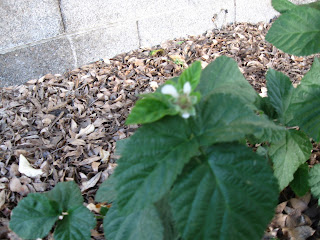
I'm still learning to use the camera. This is attempting to show a blossom on the Olallieberry bush which has grown like crazy since planted a few weeks ago. I put it in a very shady area. I do have a Brazos blackberry in a pot that I bought this week and have yet to transplant. It is supposed to take heat better than the Olallieberry.
The Aprium (a plum-apricot cross) has a few fruit.
This is one of the miracles, a melon plant growing from a seed. I planted just a few melon seeds in the orchard area and they have all sprouted.
The artichokes keep producing new leaves while the bottom leaves get crispy. I don't know if this is expected.
It's been extra cool this year. Spring was delayed about three weeks. The year before we had a late hard freeze. I have had a few eggplant transplants die and the peppers don't seem too happy. I may replant the eggplant next week since I think it is finally warming up.

Well OK, it does look lovely anyway. I love getting up each morning and slowly surveying all the changes.

Tuesday, April 08, 2008

April Garden Guide from the Arizona Republic

http://www.azcentral.com/arizonarepublic/home/articles/0405aprilgarden0405.html

I don't know if it's OK to quote the whole article but one of my goals in starting this blog was to pull together information like this to help me plan better in future years.

The Arizona Republic credits the following sources for the information in this article:
University of Arizona's Maricopa County Extension, ag.arizona.edu/Maricopa/
Growing Roses in the Desert Southwest, edited by Dona Martin
The Low Desert Herb Garden Handbook, edited by Anne Fischer.

My comments - I don't have grass so I know nothing about the recommendatios for lawns but I left them in for completeness. Don't forget to change your irrigation timer and programming if you have one. I am keeping a log of my settings for future use.

April Garden Guide

The Arizona Republic, Apr. 5, 2008 12:00 AM

Now through October, when plants face the harshest combination of extreme sun exposure and heat, follow a few rules to keep plants irrigated and looking their best.

One rule to especially remember: Deep, infrequent watering is better than a daily sprinkle. What's deep? Watering to penetrate the entire root zone of a plant and no more. Unlike watering a potted plant, where water stays in the pot to be absorbed by the roots, water on the ground doesn't hang out by the root zone indefinitely.

Once water passes the root zone, it keeps on going, wetting the soil, but not benefiting the plant. Although a daily sprinkle might wet the surface of the soil, benefiting shallow roots, the surface is where the plants are exposed to the heat, sun and wind. Deep water encourages deep roots, making a stronger, healthier plant.

When it comes to plant watering, remember: Water to:
  • 1 foot deep for turf, annuals, cactuses, succulents and ground covers;
  • 2 feet deep for shrubs;
  • 3 feet deep for trees.

To measure, start watering the lawn. Take a screwdriver with a long shaft. Jab the screwdriver into the ground and push. If you're nowhere near 12 inches, keep watering for another 15 minutes. Test again.Once you can push the screwdriver 12 inches into the ground easily, stop watering.

Probe tools or lengths of rebar will work for testing water penetration on larger plants. In general, new plants and rosebushes need to be watered more frequently than desert-adapted plants and those that have been in the ground for more than a year. Contact your city water department, or the University of Arizona's Cooperative Extension master gardeners, ag.arizona.edu/maricopa/ or 602-470-8086, to get free literature and advice on lawns and landscaping.

Edibles

The number of crops to plant declines dramatically - there's just enough to keep many green thumbs happy. Growing veggies and herbs from seed is an inexpensive activity. Follow the seed packet's directions for when and how to plant.

  • Plant seeds of basil, garlic chives, lima and snap beans, black-eyed peas, cucumbers, green onions, melons, okra and summer squash.
  • Transplant basil, lemon grass, lavender, peppers/chiles, mint and rosemary.
  • In hot weather, lettuces and spinach bolt quickly, forming tough seed stalks and causing leaves to turn bitter. Save the seeds for next season, or remove plants and add to the compost pile.
  • For a schedule of vegetable planting dates for Maricopa County, go to ag.arizona.edu/maricopa/.

Ornamentals

Before buying a tree to plant on Arbor Day (April25), ask yourself these questions:

  • Am I adding a tree for shade or privacy or to hide an unsightly view or to hang a hammock?
  • Do I want a fruit-bearing, flowering or thorny tree?
  • Do I prefer a tree that keeps its leaves year-round or loses leaves in the late fall?
  • How much time and money do I want to invest in fertilizing, pruning, watering and raking leaves?

Roses may need a few sprays of a fungicide, such as Immunox or Funginex, every week to prevent powdery mildew. A regular application of pesticide, such as Bayer Rose and Flower Insect Killer, can ward off aphid and thrip attacks.

For summer or fall blooms, plant native or adapted flowers such as prairie zinnia (Zinnia grandiflora), desert marigold (Baileya multiradiata) or cosmos (Cosmos sulphureus).

Grass:

  • Mid- to end of April is the best time to seed or sod bare spots or overseed thinning grass.
  • A good choice for Valley lawns is Bermuda grass.
  • In shady areas plant dichondra, which is not a grass, but a low-growing plant.
  • When laying sod, water well and let grass grow long before mowing.

Maintenance

The well-tended April garden is abundant with growing, blooming plants at their peak.

A neglected April garden can be overgrown with weeds, in need of pruning and watering. Look around and assess what worked, what needs to be moved and which area could use a pick-me-up provided by flowering shrubs, sculptural succulents or ornamental grasses.

  • Plenty of hot months ahead. Check pots to ensure they are not drying out.
  • Add mulch on pots and beds where it has thinned.
  • As conditions dry, ensure veggies and fruit trees do not suffer.
  • Water in the early morning or early evening hours.
  • Tomatoes in particular can fall victim to various ailments if their water supply varies significantly. Place 50 percent shade cloth over tomatoes to keep leafhopper insects away and to prevent curly top virus. The virus affects more than 150 plants in the Southwest, severely stunting and killing vegetable plants. Check citrus trees, whose shallow roots can suffer when conditions are very dry.
  • Continue to deadhead annuals and perennials to promote more flowers.
  • Begin fertilizing Bermuda-grass lawns during late April or early May. Follow directions on the container.

Sunday, April 06, 2008

Garden Design & Pictures


I have acquired a camera and taken a few pictures. Here's a shot of the cheerful pansies I can see out my back sliding doors.

Here is an overview of the garden layout.The Street is at the top (North) and the gate at the bottom (South) leads to the alley where shared garbage and recycling bins live.
The front yard is a desert landscape, low water usage plants and trees on drip irrigation. I'll describe this with pictures in a later post. The house is a typical 1950's rancher made of concrete block - typical for Phoenix anyway.
The whole yard has decomposed granite instead of the grass that was there when we bought the
house.
We used to have a swimming pool but last spring we had it completely removed and filled in.

The pool did look nice. Here's a picture taken with my cell phone camera two summer's ago. Unfortunately when the pool was removed, they removed the broken concrete patio which we loved.

After removing the pool (alas, no photos of the bulldozers), we let it sit for a while to see if the dirt would settle anymore. It stayed level. In November 2007 we had all new irrigation, large raised planters and a mulched orchard area installed. A line for container pots was also installed.

The orchard area is the 12 feet from the back of the raised planters to the existing six foot high block wall that surraounds the back yard. The orchard and the big raises planters are on in-line drip irrigation, called Netafim, which was invented for argicultural use in Israel.
This picture was taken from the East side facing West. The tree is a Chinese Elm. It leafed out in late March.


Here is a closer view of the raised planter on the East side. You can see (from left to right in the orchard area) the new peach trees, a plum, a citrus, an aprium and a Meyer lemon. The gate leads to the alley. The planter is planted with tomatoes, herbs, artichokes and lettuce.

This picture looks East from the Elm tree. The swimming pool used to be in that open area and where the planters are now.
I recently pruned the citrus. My goal is to keep them under 8 feet so I don't have too much fruit from any one tree. Also I'd like to be able to prune and pick without getting on a ladder.
The citrus trees shown are a thornless Mexican lime (very vigorous!), two blood oranges, a grapefruit and orange planted closely together in the corner.
Our other Meyer lemon is to the right of several smaller citrus and some other trees that were recently planted.
That's our dog Ralphie, investigating the containers. I can't resist adding a close-up of Ralphie.

We had various problems with the irrigation but the installers have worked with us and I think it is all working as planned now. I worked with a local company that focues on sustainable landscaping.

I have been a little unhappy with the fill for the raised planters as it is a very coarse woody material which has not worked well for seeds or transplants. The same material was used to put in about 6 inches of mulch in the orchard area and it works great there.

I planted a lot last fall/winter and nothing thrived except one rapini.

A few weeks ago, once the irrigation flooding was solved (a valve problem), we added a lot of finer organic compost to all the raised beds, plus compost tea and fish emulsion. I planted a lot of seeds in the East bed - they are are not doing well. Birds seem to be getting the few that do emerge.

I expect the soil will be better next year after the wood has broken down more. The compost tea and fish emulsion are really helping too.

This week I was excited to get our first tomatoes. This is late, we may not get a harvest before the hot weather stops everything, but I am still excited.


Things grow so fast - here are the first cucumber blossoms.
The squash plant has it's first blossom, complete with tiny pattypan squash. It is planted in the same spot that produced a great rapini plant over the winter so there is something good in the soil in that spot. I planted a yellow squash, a green squash and a yellow zuchinni. Also a 6-pack of green zuchinni in a different area. I wanted to have at least a few things that are easy to grow.


The Mission fig tree on the West side of the house is growing fast. Last year the birds got all the figs but we have hopes for this year. It is not in the orchard area so I am hand watering it. I am hoping for good shade on the Western side of the house in a couple years.